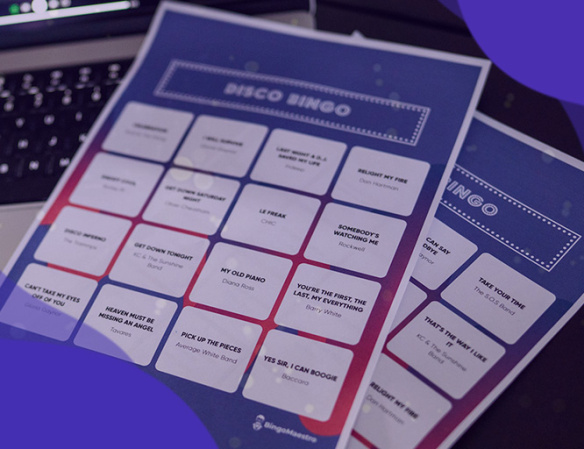
What Does a Singo Bingo Card Look Like?
A standard Singo card uses a 4x4 or 5×5 grid, giving 16 or 25 squares. Most sets include a free center square (no song needed, always marked), which creates a slightly shorter path to a winning row.
Each square contains:
The song title
Sometimes the artist name as a hint (especially useful for less music-savvy groups)
Cards are typically printed on A4 or A5 paper and designed to be written on with a pen, or laminated for reuse with dry-erase markers. Digital versions are also common, players mark off songs on a phone or tablet screen, which works particularly well for online events via Zoom or Teams.
How Many Singo Cards Do You Need?
The answer depends on your group size and how you want to play: A good rule of thumb: always print 10–15% more cards than you have players. Late arrivals, torn cards, and last-minute additions happen at every event.
What Makes a High-Quality Singo Card?
Not all Singo cards are created equal. Here's what separates a great card from a frustrating one:
Readability
Text should be large enough to read in a dimly lit bar or at a crowded party table. Cards that try to fit too much information in each square become hard to scan quickly — especially during a fast-paced round.
Unique card layouts
Every card in a set must have a unique arrangement of song titles. If two players have the same card, they'll always win or lose together — removing the competition entirely. Professionally made card sets randomize layouts algorithmically.
Balanced song distribution
Songs should appear roughly the same number of times across all cards in a set. If one song appears on 90% of cards and another on 10%, the game becomes unpredictable and frustrating. Well-designed sets distribute songs evenly.
Matching playlist
The card must only contain songs that are actually on the playlist being played — and every song on the playlist should appear on at least some cards. Mismatches between playlist and cards are the number one cause of confusion and complaints during Singo.
Print quality
Cards should be crisp and legible when printed in black and white as well as color — not every event has access to a color printer.
Landscape vs. Portrait Cards: Which Is Better?
Both formats work, but there are practical differences:
Portrait (A4/A5 vertical): Easier to stack and distribute, fits naturally on most tables, familiar to players used to traditional bingo cards.
Landscape (A4 horizontal): Can sometimes fit two cards on one A4 sheet (useful for saving paper), but feels less natural to hold or lay flat at a table.
For most events, portrait format on A4 is the practical choice. BingoMaestro cards use this format by default.
Can You Make Your Own Singo Bingo Cards?
Yes, and it can be a fun project if you have the time. Here's how:
Choose your songs: Pick 25–50 songs for your playlist. Fewer than 25 means every card will be identical; more gives more variation.
Create the grid: Use Word, Google Docs, Excel, or an online bingo card generator.
Randomize layouts: Manually shuffle the song positions for each card, or use a generator that does this automatically.
Add a free space: Mark the center square as a free space.
Print and laminate for reuse, or print single-use copies.
The honest challenge with DIY cards: Getting the distribution right across 20+ unique cards by hand is tedious and error-prone. If you're making cards for a group of 10 or fewer, DIY is manageable. For larger groups, the time investment rarely makes sense compared to a ready-made set.
Ready-Made Singo Cards from BingoMaestro
BingoMaestro's Singo card packs include everything you need to play immediately:
Professionally designed, print-ready cards — unique layout per card, balanced distribution
Matching playlist — every song on the cards is in the playlist, and nothing extra
Host guide — so you know exactly how to run the game
Instant digital delivery — in your inbox within 5 minutes of ordering
One-time purchase, unlimited use — buy once, play as many times as you like
Available in dozens of themes: 80s hits, 90s classics, pop anthems, rock hits, Christmas, rock, R&B, and more.
→ View all ready-to-play Singo card packs
Frequently Asked Questions About Singo Cards
Can I reuse Singo bingo cards?
Yes. Laminate the printed cards and use dry-erase markers to mark them off during each round. After each round, wipe clean and play again. This makes a single set usable for dozens of events.
How do I prevent two players from having the same card?
Use a card set with algorithmically randomized layouts. Professionally made sets guarantee unique cards. If making your own, double-check that no two cards have the same arrangement before printing.
Can I add my own songs to a BingoMaestro card set?
Custom orders are available for groups who want a fully personalized playlist — ideal for birthdays, weddings, or themed corporate events.
What size should I print Singo cards?
A4 is the standard. You can scale down to A5 if you want to fit two per sheet, but the text becomes small. For larger groups or low-light venues, stick with A4.
Do the cards work for online Singo via Zoom?
Yes. Send the PDF cards to players before the call, or use digital cards players can mark on-screen. Both methods work well for remote events.
Next Steps
New to Singo and want to understand the game first? → What Is Singo?
Ready to host your first game? → How to Host a Singo Bingo Game
Want a complete pack with cards and playlist? → Browse our Music Bingo games