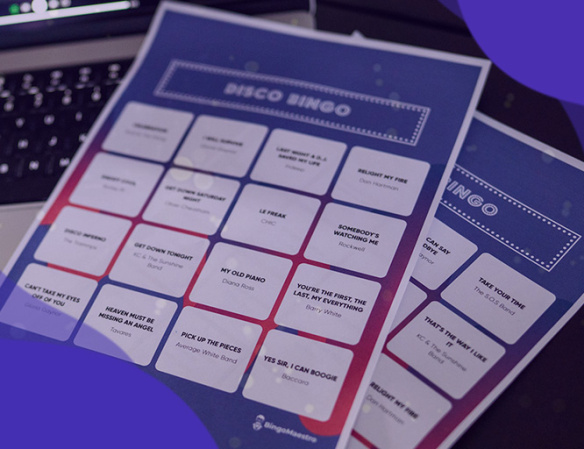
🎉 Ready-to-play Music Bingo
Feel like playing Music Bingo? Choose from our ready-to-play games!. In your mailbox within 5 minutes 🚀
What You Need to Host a Singo Game
Before you start, gather these essentials:
Singo bingo cards — one per player (plus a few spares)
A playlist — matched to your cards
A speaker — loud enough for the whole room
A device to play music from — phone, laptop, or tablet
Markers or tokens — pens, poker chips, coins, or anything players can use to mark their cards
A host — someone to manage the music, keep energy up, and verify winning cards
Optional: prizes for winners (drinks, vouchers, novelty gifts)
That's genuinely it. No app required. No special equipment. No technical setup beyond a working speaker.
How to Host a Singo Game: Step by Step
Step 1 — Choose your theme and playlist
Pick a music theme that fits your audience. This is the single most important decision you'll make as a host.
Theme ideas by audience:
Mixed age groups → 70s/80s/90s crossover
Young adults → 00s hits or current chart pop
Work events → crowd-pleasing classics, nothing divisive
Kids' birthday → Disney, kids' pop, nursery rhymes
Christmas party → all-time festive hits
Pub night → genre-specific (80s rock, 90s R&B, Britpop)
Keep the playlist to 30–40 songs per round. This creates enough variation for multiple unique cards while keeping rounds to around 20 minutes.
Step 2 — Get your Singo cards
Print your Singo cards or order a ready-made set. Make sure every card in the set matches the playlist — all songs on the cards should be in the playlist, and no songs should appear on the cards that you're not planning to play.
Print one card per player. For events with 20+ people, print extras.
Step 3 — Set up the space
Place a card (face down) and a pen or marker at each seat before guests arrive
Test your speaker and music playback before the game starts
If the room is large, consider whether players can comfortably hear from all positions
For bar or pub settings: distribute cards at tables, with one winner per table advancing to a final
Step 4 — Explain the rules (keep it short)
Before the first round, give players a 60-second explanation:
"On your card you'll see song titles. When you hear a song that's on your card, mark it off. First person to complete a row shouts Singo — I'll verify the card. We'll play [X] rounds. Ready?"
That's all they need. Don't over-explain. The game teaches itself within the first two songs.
Step 5 — Play the first round
Start the playlist. Play 15–30 seconds of each song — long enough for players to recognize it, short enough to keep the pace up.
Host tips during play:
Keep energy high between songs — a short comment or reaction goes a long way
Don't announce song titles as you play them (that removes all the challenge)
If someone calls Singo, pause the music and verify their card before continuing
If the card is wrong, the game continues — mark their card as disqualified for that round
Step 6 — Run multiple rounds
One round is never enough. Plan for at least two or three rounds per session. You can:
Use the same playlist in a different order
Switch to a different theme for the next round
Increase difficulty: require a full card instead of just a row
Allow a short break between rounds — people need to refill drinks, reset cards, and talk about that impossibly obscure track you snuck into the playlist.
Hosting Singo in Different Settings
At Home
Home Singo is the most relaxed format. With 6–15 players around a table or living room, you can pause for discussion, replay debated songs, and take it at whatever pace suits the group.
Tips for home hosting:
Use a Bluetooth speaker pointed toward the group
Keep rounds shorter (20–25 songs) for a lighter session
Make it a recurring thing — themed nights ("90s only", "one-hit wonders") build anticipation
At a Pub or Bar
Pub Singo works brilliantly as a weekly event format. Players buy in, receive a card, and compete for a prize — usually a bar tab or voucher.
Tips for pub hosting:
Use a PA system if the room is larger than 30 people
Set up clearly marked tables so players know where to sit
Run table heats followed by a grand final round
Keep the energy between songs — this is entertainment, not just a game
At a Corporate Event or Team Building
Office Singo is one of the most universally popular team-building formats because it requires no prior knowledge, no physical ability, and creates instant cross-team interaction.
Tips for corporate hosting:
Choose a universally accessible playlist (avoid anything too niche)
Mix teams deliberately so people who don't normally work together share a table
Keep it to two rounds — it's an activity, not the whole event
Offer symbolic prizes that don't embarrass anyone (e.g., the winner gets to leave the next team meeting five minutes early)
At a School or Fundraiser
Singo works at all school ages with the right playlist. It also raises money effectively as a ticketed event.
Tips for school and fundraiser hosting:
Age-appropriate playlists are non-negotiable — know your audience
Charge per card for fundraisers (multiple cards per player increases income and engagement)
Use a microphone if the venue is a hall or gymnasium
Appoint a student helper to distribute and collect cards between rounds
At a Birthday Party
A Singo round built around the birthday person's favorite music is an instantly personalized experience. A playlist of songs from their birth year, their favorite artist, or their most-played tracks makes the game feel like a tribute as much as a competition.
Tips for birthday Singo:
Involve the birthday person in building the playlist in advance (or surprise them)
End the last round with their most loved song as the "final call"
Print cards with a custom header: "[Name]'s 40th Singo Night"
Singo Bingo Near Me: Do You Need a Local Supplier?
One of the most searched phrases around Singo is "singo bingo near me" — and the good news is that you don't need a local provider to host a great game. BingoMaestro delivers complete Singo packages digitally, within 5 minutes of ordering. You print the cards yourself, use any Spotify or Apple Music playlist, and host in your own space. There's no shipping, no waiting, and no need for a local supplier. Whether you're in Amsterdam, Rotterdam, Maastricht, or a small town with no local game nights — you can host a professional-quality Singo event tonight.
→ Browse all Singo game packages
Frequently Asked Questions About Hosting Singo
How long does a Singo game night last?
A typical two-to-three round session takes 60–90 minutes including setup, breaks, and prize-giving. A single round takes 20–30 minutes.
Do I need to be a DJ to host Singo?
Not at all. A phone, Spotify, and a Bluetooth speaker is sufficient for groups up to 30 people. For larger venues, a PA system is recommended but no DJ skills are needed.
What if players dispute a song?
Have a quick rule in place before the game starts: the host's decision is final. If you want to be fair, offer to replay the song once for disputed calls.
Can I charge guests to play Singo?
Yes. Singo works well as a ticketed event. Charge per player or per card. Multiple cards per player increases revenue and player engagement simultaneously.
Can Singo be played online?
Yes. Distribute card PDFs before the call, share your screen or audio on Zoom or Teams, and play normally. Digital Singo has been popular since 2020 and works smoothly with a basic setup.
What's the minimum number of players?
Singo works with as few as four players, though it gets more fun and competitive with 10 or more.
Get Started Tonight
You have everything you need to know. The only thing left is to play.
Understand the game first → What Is Singo?
Sort your cards → Everything About Singo Bingo Cards
Get a complete ready-to-play package → Browse Music Bingo Games